DevOps Explained: How It Bridges the Gap Between Development & Operations for Faster Innovation
For decades, a great divide existed in IT departments. The Development team (Dev) was measured on innovation and shipping new features. The Operations team (Ops) was measured on stability and keeping systems running. This created a conflict: Dev would build and "throw the code over the wall" to Ops, who were left to deploy and maintain it, often leading to finger-pointing, slow releases, and midnight firefighting sessions. DevOps is the philosophy that dismantles this wall, creating a unified, automated, and collaborative lifecycle for software delivery.
DevOps is a Culture, Not Just Tools.
At its heart, DevOps is about breaking down silos and fostering shared responsibility. Developers gain awareness of the operational requirements (like performance and security), and operations staff get involved earlier in the development process. The shared goal becomes the rapid, reliable delivery of value to the end-user.
The Technical Engine: Automation & Continuous Everything
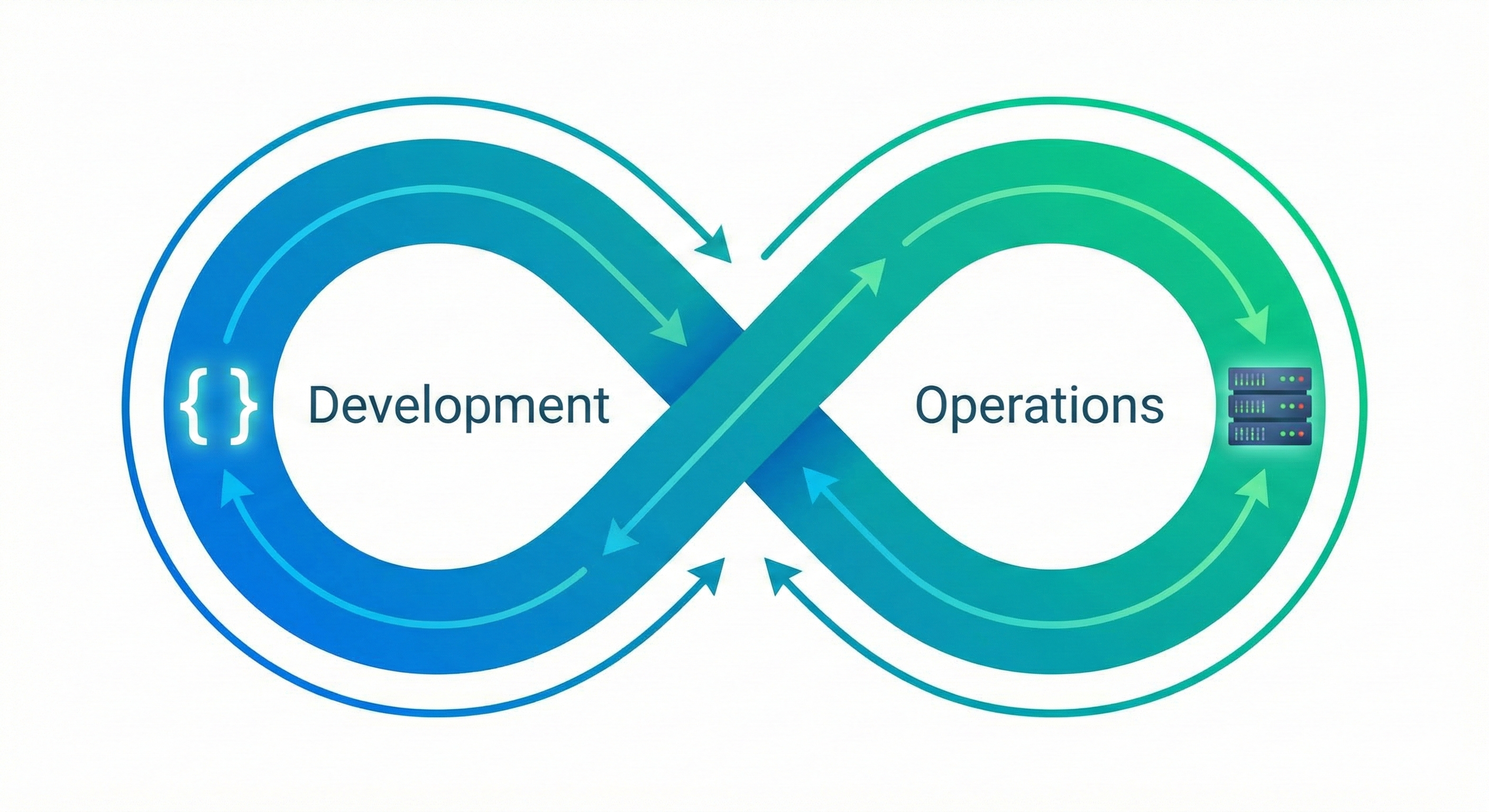
Culture is enabled by practices and tools that automate the software delivery pipeline. This is often visualized as an infinite loop:
Plan & Code: It starts with agile planning and developers writing code in small, manageable chunks.
Build & Test (Continuous Integration - CI): Each time code is committed, it's automatically built and tested. This catches bugs immediately, when they are cheapest to fix.
Release (Continuous Deployment - CD): Code that passes tests is automatically deployed to a staging environment and, if all checks pass, can be automatically deployed to production. This enables frequent, small, low-risk releases instead of big, scary "big bang" launches every six months.
Operate & Monitor: The application is now live. Automated monitoring tools watch performance, user experience, and errors in real-time.
Learn & Feedback: Data and feedback from the live environment are fed directly back to the development team, informing the next cycle of planning and coding. This closes the loop.
The Tangible Business Benefits:
Speed & Market Agility: Release new features, fixes, and experiments in days or hours, not months. Respond to market changes and customer feedback with incredible speed.
Improved Reliability & Stability: Automated testing and incremental changes make each release more predictable. Rollback from a problem is fast. Mean Time To Recovery (MTTR) plummets.
Enhanced Collaboration & Morale: Eliminating the blame game and creating a shared mission builds a more positive, productive, and innovative engineering culture.
Security (DevSecOps): By integrating security practices and scanning into the automated pipeline ("shifting left"), you find and fix vulnerabilities early, making security a part of the process, not a last-minute audit.
Getting Started with DevOps:
You don't need to overhaul everything at once. Start by automating one painful part of your process—like testing or deployment. Encourage a joint Dev/Ops lunch-and-learn. Adopt a single collaborative tool. The goal is to move from a linear, gated process to a collaborative, automated, and continuous flow. By bridging the Dev and Ops gap, you don't just build software faster; you build better software that delivers continuous value.